Backyard Wildlife

Turn on Discovery Channel, Animal Planet, or Nat Geo Channel, and you will probably be able to find a couple cool shows about exciting animals. Fierce predators, insanely huge fish, marine mammals that you just want to cuddle to pieces – really interesting stuff! The downside is that most wildlife shows focus on “exotic” animals. You’ve probably even seen a show on something like arctic foxes from the tundra or elephants herd on the African grasslands, but a PBS Nature special your own backyard wildlife? Maybe not quite as common. So how about we take a firsthand look at what’s in our own neighborhoods together? How will we do that?

Ladies and Gentlemen, for my next trick, I would like to make pictures out of thin air! Well, I’ll take pictures with a strategically placed trail camera that is motion-and-heat-sensing to allow snaps of moving animals but not the blowing wind. Doesn’t quite have the same ring to it…ah well.

Trail cameras, or camera traps, are a fantastic way for researchers to observe elusive wildlife (like snow leopards or Andean bears), and state and federal agencies use them monitor wildlife populations across the country. I used a trail camera in my Wildlife Monitoring class that I taught at the Pittsburgh Zoo and PPG Aquarium, and I’ve heard of some school districts allowing teachers to use them for class projects. But, honestly, they can also be useful for learning on your own or with your kids.

If you guys would like to play along at home, I bought this camera:
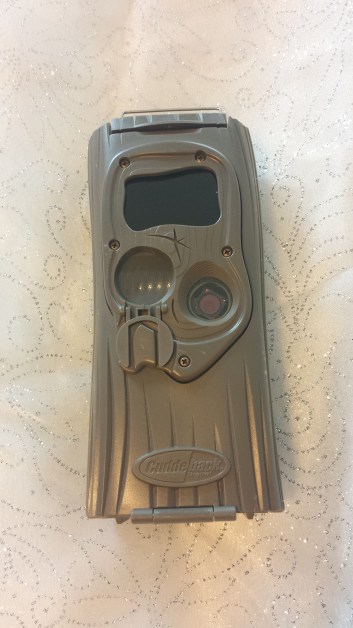
20160630_141146

Sparkly background not included

It’s a Cuddeback trail camera that I got from Cabela’s for $99. Though often used by hunters, I just want to scope out what kind of wildlife is right there under my nebby nose. I’m setting this up today in the backyard of a friend’s house, so I will be sure to share with you all as soon as I have some images!

For those of you want to try this, I would highly encourage you to give it a whirl. If you’re concerned about the price, let me know and I can try to put folks in touch if they would like to share a camera. Land owners, you might be amazed with what visits your property. If you really don’t have any space (I don’t either, no worries), it might worth a try to ask a local park if they would let you do a trail camera survey for fun. They might be interested in what you find as well! Just be sure when you’re using a camera that you obey all local ordinances involving privacy, and if it’s not your land, ALWAYS get permission first!

Once you’ve found a camera, it simply needs to be placed (mine straps around a tree), and then left alone. Super easy. Do keep in mind where the camera is pointing, or you will have pictures of either all dirt of all tree top. I would also recommend checking your camera on a regular basis to be sure it isn’t stolen or damaged. Beyond that, if you’re just placing a camera for the joy of learning, it’s a very simple process. (If you are interested in more technical details for research or wildlife management, see here.)

In the past, I’ve used my trail cam in the Highland Park area in Pittsburgh. We’ll see what I find next in the North Hills!
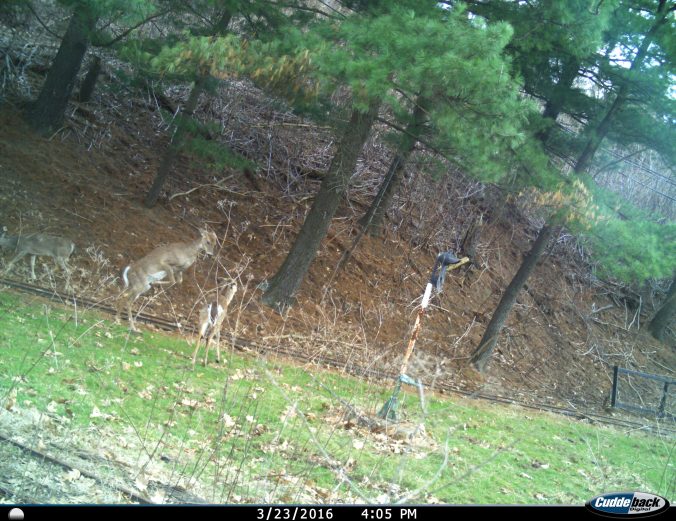
I__00060

That was MY clover!!

I__00007

Female at night

I__00027

Young buck at night

I__00005

Ahh, the elusive Maria Sleeve.

Find the Frogs!

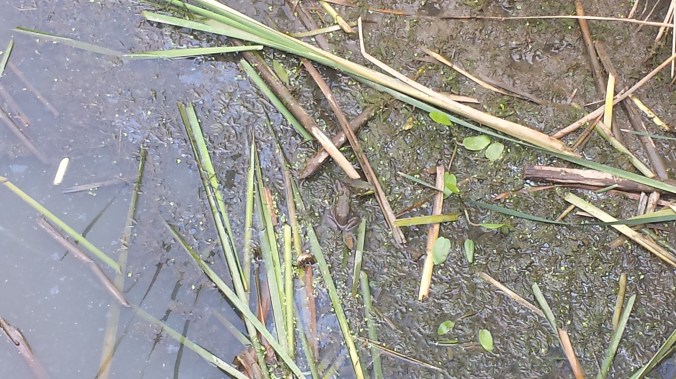
Over the weekend, the hubby and I had a few minutes to take a walk around my parents’ neighborhood in central Ohio. Though firmly rooted in the suburbs, we came across the tiny remainders of a wetland (presumably drained) at the edge of the neighborhood. Cattails grew on both sides of what had turned into something a drainage ditch, and duckweed and some sort of potamogeton floated here and there in the shallow water. What we enjoyed best though–frogs! It may have been a small space, but this little patch of habitat was crowded with green frogs. I only had my phone on me, but I snapped a few pictures that I thought would be fun to share. Can you find the frogs in the pictures below?

one frog_easy

One frog here…not too hard to find.

one frog_harder

A little tougher…

two frogs

Oh that camouflage…

Found the frogs? Excellent! Now, while I have the floor, I do want to highlight a few things about frogs that are super important.

  • Frogs, along with other amphibians, are invaluable as indicator species. If there is a problem with a habitat, frogs and salamanders are among the first kind of living things to struggle because of their thin semi-permeable or permeable skin. And this is very important: if there is a problem with a wetland or a waterway, it’s not just a problem for “nature.” It’s a problem for us as well.
  • Amphibian populations around the world are declining. There are a number of speculated causes, but high on the list are habitat loss and the spread of the chytrid fungus.
  • Why are frogs helpful for you? For one thing, their diet includes a number of pesty insects including (wait for it)…mosquitoes. So, if you’re not a fan of getting bitten by creepy crawlies, you like frogs.
  • Why else are frogs helpful for you? A looming medical disaster is the rise of antibiotic resistant bacteria. Countless numbers of human lives have been saved over the past several decades through the use of antibiotics, but a shadow is falling over that triumph as bacteria have begun developing resistance to what used to be effective treatments. However, antimicrobial peptides from frogs’ skin secretions may be one of the hopes for the future of bacterial infection treatment. If we keep our frogs safe, we might also be safeguarding medicines for the next generation. (P.S. This is for another post, but I can’t help it: you can help slow the rise of antibiotic resistant bacteria. If you are prescribed an antibiotic, be sure you use the medication only as directed by your doctor. Please do not Google “Do I have to finish my antibiotics.” Your doctor examined you; a blogger with an opinion did not. That includes me! Also, be aware that antibiotics are useless against viral infections, so don’t pressure your doctor if they say you’ll just have to wait it out. Most importantly: never share medication. Now back to frogs!)
  • If you still don’t believe me about how crazy cool frogs are, trust the experts at the Smithsonian! If anyone has fun facts, they do 🙂

Top Ten *Free* Summertime Learning Adventures in Pittsburgh

Stay tuned for Part II of the honeymoon story 😉 And while my brain may still be a bit locked in beach/honeymoon mode, overall I remain on a quest to find educational and super fun things for folks and families to do over the summer. Very important key to this, though, is budget. All the costs of summer time fun can add up quickly, but one of the many things I love about Pittsburgh is the awesome variety of things to do for free. Free! My favorite word.

So if you’re still looking for some fun ways to stimulate creativity and engagement, while not breaking the bank, below are the top ten places that offer free family learning adventures you can explore this summer. Just as a side note when you’re exploring the event pages, for a number of the facilities listed below, free programs are mixed with cost programs. Nothing outrageous, just something to keep in mind. Also, some of these activities are great not just for families but for singles, couples, groups, Uncle Louie, whomever!

  • Allegheny County Parks ~ Hometown Hoops minicamps and swimming classes (free swimming classes only held at Boyce Park, South Park, and Settlers Cabin Park)
  • Carnegie Libraries ~ Story times, Teen Times, Craft Time, Gamer Time (??), and Author events
  •  Allegheny Observatory (The stars, people! The stars!) ~ Free, but reservations required, ages 8 and up
  • Assemble Pittsburgh ~ M3 programs free over the summer—arts, materials, and building for 1st-8th grade

Of Honeymoons and Conservation, Part I

I already knew that I had picked an awesome Life Adventure Buddy (aka husband), but I think our honeymoon added an extra layer of confirmation to that idea. Rob and I didn’t plan any sort of theme when we decided on Palm Beach, Florida; we just wanted to do fun things in the area. And for both of us, “fun things” ended up meaning trips to natural parks, wildlife centers, a zoo, and beach, beach, beach! It’s pretty fantastic when you share quirky interests 🙂 Since we had a great time on our trip, and I’m eager to relive the sun and the sand, I figured I’d share some of our journey along with the conservation tidbits we picked up.

.

The first day of our trip, we spent a day (of course) at the beach where I was reminded of the vast awesomeness of the ocean. I know all the geographical facts (Europe is that way, Africa is that way), but when you stand on the shore and realize just how tiny you are—it’s hard to explain, but the majesty of the ocean just feels like anything is possible, that limits don’t exist. If I could fly, I would soar as far out into the blue as I could and revel in the utter freedom. If I could sail my own ship directly above the Mid-Atlantic Ridge, I would sing every song I know, as loudly as I want, and never have to stop or bother with that whole being “in tune” business. And who knows…with thousands of square miles of the open sea, maybe there really are elusive dragons or a ship of femme fatale pirates still searching for treasure out there—all just waiting to be immortalized in the pages of fantasy. Besides my dreamy side, the oceanic perspective was a mindbender in a spiritual or philosophical sense as well: if God is all-powerful and the universe is infinite, how can I not even comprehend the bigness of some saltwater? Not even a drop in a proverbial bucket of planets, stars, and hosts of galaxies? Yet here it is…so open that I can see no end. Mind boggling.

~

20160510_120308

~

Of course, the other strange thing to wrap my mind around is how my seemingly insignificant self can impact something so great. Many of us are aware of our oceans’ troubles (rising sea levels, rising temperatures, non-point source pollution, etc), but I always want to remind folks that we really can make a difference! Even if you’re landlocked, the simplest things like recycling, opting for reusable shopping bags, turning off lights and electronics when not in use, and minimizing pollutants that make it to the oceans via run-off and watersheds—all of that can make a tremendous positive impact for ocean conservation if we make a collective effort.

.

After a glorious day of splashing through waves and making sand art (I got pretty fancy), we visited a sea turtle rescue facility called Loggerhead Marinelife Center. On any given day, volunteers and staff are caring for loggerheads, greens, Kemps Ridleys, hawksbills, and even leatherbacks that have somehow run afoul of nature or humans. On the day we visited, one lucky loggerhead was about to be released after a thankfully mild experience with a fish hook and line! Other turtles (like Betty White, story below), had been at the facility for a few months while injuries or infections were carefully tended to by skilled vets.

~

20160511_114812

Rob and I with Shertz, a loggerhead sea turtle who had been cold-stunned in Cape Cod and arrived at the center with a hole in her carapace (top shell). She’s progressing well and will hopefully be released soon!

20160511_111734

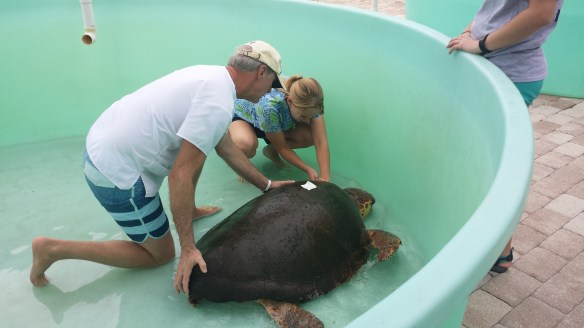
A vet and volunteer performing routine check-up on Betty White

20160511_111527

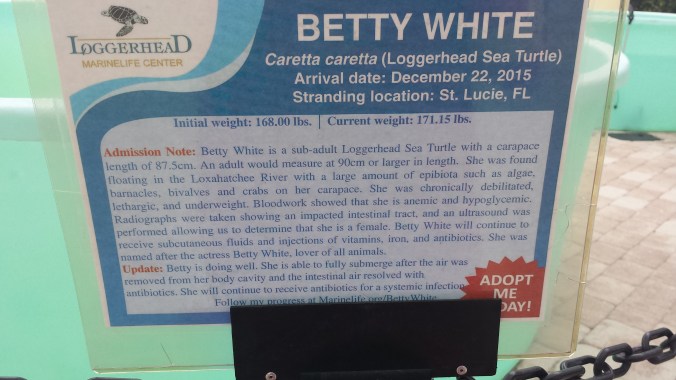
Betty White’s story

20160511_113759

~

The center also kept track of sea turtle nesting on the beaches in the area. Since humans and artificial light sources can pose a huge problem to little hatchlings, volunteers try to make sure sea turtle babies are able to safely incubate, emerge, and seek out the ocean uninterrupted.

 ~

20160511_130818

~

Turtles and the ocean are pretty darn cool, but the adventures didn’t stop there! Next, we visited Manatee Lagoon, a manatee education center sponsored by one of Florida’s energy companies. What I loved about this facility was its bluntness about threats to manatees, yet still the accessibility of the information. Boat strikes are a huge problem for manatees, and the material at Manatee Lagoon didn’t shy away from this. However, the information was still presented in a truthful yet gentle enough way for even children to learn to be responsible boaters as adults. Plus, the manatee life history information was presented from the standpoint of “Mia,” a cartoon manatee ready to share valuable information to families!

~

20160511_172523

~

While at the lagoon…we were super lucky! Only one manatee passed by the facility all day, and it just happened to be during our short visit! I might have squealed a little bit…

~

20160511_145631

The one manatee to pass by all day…so excited that we saw her/him!

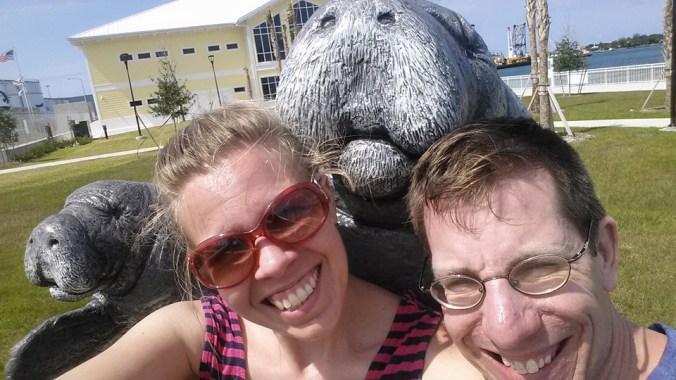
13177603_10100122727031375_5293502325652625195_n

Hey look! We got a picture with a manatee!

Well, we had a few more days of exciting, but I think I will leave you with a cliff-hanger. What did we see next?? I guess you’ll have to come back to check 🙂

~

Peace, love, and manatees!

More Summer Time Happenings

Earlier this week, I posted a tidbit on how to keep your family’s summer full of science. One other way to add a splash of learning fun to your kids’ summer is to look into the day camps offered in your area. Since I live in Pittsburgh (and I must say, we are spoiled with the resources we have in this city!), my suggested camps are a bit biased to the general Western PA area.  However, some quick searching online will most likely reveal some exciting opportunities no matter you are. Start with your local museums and even universities. They often partner with organizations for fun educational camps.

If camp costs are in issue, which they most certainly can be, check to see if scholarships are offered before going another direction. Many of the camps listed below have funding ready to help families with the cost, especially if multiple kids are involved. And if that doesn’t work out, I will say this: Don’t Underestimate Your Local Library. Besides Vacation Bible School, I only went to camps a few times as a kid myself, but we took part my local library’s activities on a very regular basis. In Pittsburgh, we have the fantastic Carnegie Library that offers classes and programs for all ages—toddlers, kids, teens, and adults. Take advantage of that! Even if you go to camp!

Pittsburgh Camps with A Science or Nature Theme

Pittsburgh Park Conservancy— Go outside! Get muddy! Learn about the habitats of western Pennsylvania! It will be glorious J Their camps run for 3 years olds up to kids just finishing 7th grade. http://www.pittsburghparks.org/summer-camps

Carnegie Museum of Natural History—I’ll admit, I love animals and I love the outdoors, but the museum has a lot of local institutions beat when it comes to variety. Offering different-themed camps almost every week—plus nature camps out at their field station, Powdermill Nature Reserve in the Laurel Highlands—I would be willing to bet my Wonder Woman mug that there is something for everyone through the museums camps. http://www.artandnaturalhistory.org/camps/

Carnegie Science Center—Like the natural history museum, the science center features a variety of different camps focusing on anything from Mars to robotics to the chemistry of the kitchen. There are different topics every week for the different age groups (ages 4-12+), and they do a fantastic job of showing how science is mixed into so many tiny corners of our everyday lives! And they do it with games and snacks. Really hard to go wrong with snacks. http://www.carnegiesciencecenter.org/programs/summer-camps/

Animal Friends— A creative approach to teaching children the responsibility of taking care of animals, the Animal Friends shelter offers a day camp that invites children ages 4-17 to learn about the care and training of companion animals. Mixed in with crafts, games, and age-appropriate activities, the camps sell out quickly, but, I’ll be honest, sound awesome! http://www.thinkingoutsidethecage.org/site/c.elKWIeOUIhJ6H/b.8627157/k.74A8/Camps_for_Young_Pet_Lovers.htm

National Aviary—As the only bird-focused zoo in the country, the aviary’s camps have a strong focus on avian conservation with a good dose of adventure mixed in! The camps are built beginning with 4 year olds who will learn what makes a bird a bird, and continue up to 18 year olds who will go in-depth with avian veterinary science and hands-on bird care. http://www.aviary.org/Summer-Camps

iD Tech Camp (CMU)—This goes a little out of my comfort zone, but if you have a budding young computer scientist, and she just can’t get enough of programming, the iD Tech Camps at CMU would be worth looking into. A part of a network of universities catching the future generation of computer scientists, the camp is an intensive program on CMU’s campus. The notable drawback is the tuition, which probably very limiting for families. However, I do believe they offer scholarships. https://www.idtech.com/locations/pennsylvania-summer-camps/pittsburgh/id-tech-carnegie-mellon-university/

Phipps Conservatory— Campers age 2-13 will learn all about caring for plants, uses for plants, conservation, and sustainability at the day camps of the Conservatory. Ok, well, the toddlers probably aren’t quite going for sustainability yet, but they will love playing with dirt and bugs 🙂  https://phipps.conservatory.org/classes-and-programs/for-children/seasonal-camps

Pittsburgh Zoo and PPG Aquarium—If your kids love animals and maybe already have that little spark of passion for conservation, try zoo camp! Every day they’ll meet new animals, play games, sing songs, and learn about how they can help protect wildlife. Older campers will get to go behind the scenes at some of the animal exhibits and meet with keepers to learn about what it’s like to work with animal ambassadors. http://www.pittsburghzoo.org/Education/ZooCamp

Summer Science at Home

Summer is almost here! If the school year was a sundae, we’d be scooping up the last of the melted ice cream and swirls of chocolate fudge from the bottom of a soda shop glass. What does summer mean for kids and families? Technically, it probably means that the schedule is already jam-packed with soccer camp, band camp, family vacation, gymnastics class, volunteering, internships, and mowing the yard.

Oh, but summer also can mean something very exciting…something that better get you hopping on the edge of your seat and reaching for a lab coat…summer can also mean…more time for science!! In the down time from school, you and your family are the lucky winners of some opportunities to keep those critical thinking skills sharp and your excitement for knowledge bouncing! Here are a few ways to keep science going at home over the summer. *Note, this post is intended for parents, but if you’re under 18 and you found it, great! Just be sure to check with a parent or guardian before trying any experiments at home.*

Make Little Bits of Your Summer Inquiry-Based

One way to keep learning minds fresh is to engage in the challenges and quests of inquiry-based learning. Inquiry-based learning means learning through experiences and probing for answers, rather than being given all the facts to memorize up front. It’s a hands-on approach. In a classroom, that could mean being presented with a case study or a scenario, and the students would need to reason through the case to eventually learn and understand the information after clarification from a teacher. The approach greatly helps with critical-thinking skills in addition to observational skills.

At home this summer, one of the things you can do as a family is try to plan for a few mini inquiry adventures. The best part of an inquiry-based or experiential learning approach is that the parents don’t need all the answers before get started. Start by picking a topic, maybe do a bit of background to give yourself a boost, and then start developing some questions that can be answered by observation or even experimentation.

For example, let’s say you want to take biology by the cornibus and visit a nature park, but you’re not quite a field naturalist yet. That is A-Ok. With an inquiry-based approach, you can arm yourselves with guide books and a field journal, and start asking questions. Try focusing on a particular aspect of the environment to keep yourself from being overwhelmed. A few question examples that don’t particularly require background knowledge but are fun to answer are below:

  • Are the kinds of plants near the stream the same or different as the kinds of plants near the meadow? Why might that be?
  • Can we hear more bird calls at the forest edge or in the forest interior? Why might that be?
  • Is there a fair bit of the scat on the ground (oh the fun with poop) or no? What kind of mammals might have been passing through?
  • What size pebbles are at the bottom of the creek? Are they big pebbles or small pebbles? Why might pebble size matter?

A key part of inquiry is to work through your questions; in many ways, that process is more important than the answer. As you reason through your question and observations, take some field notes, make sketches– just write as much down as you can. You’ll probably be impressed with what you take note of, and you will definitely be impressed with what your kids observe! And as a bonus, most parks have great naturalists you can pass on some of your questions to if you get super stumped with your guide books 🙂  It’s a great way to get more out of a hike.

Science at Home

Maybe exploring completely new territory isn’t your cup of iced coffee yet, and you want to start with a bit more guidance. Not a problem! If you’re up for a few good home-cooked adventures, here are some great resources below for easy experiments. There are instructions and explanations for the suggested projects, but I’d recommend familiarizing yourself with the concepts behind the experiments, either with a text book or a trusted source. Also, most of the projects can be done with common household items or something you can easily pick up at Target. (But beware—I ALWAYS tell myself I only need facewash and socks when I go in that store…but a new mop, two sweaters, light bulbs, throw pillows, and a box of granola bars later…)

Scientific American—Education, Bring Science  I love some of the projects on this page. Many of them seem geared for roughly fourth grade and up, but honestly, younger kids would probably like many of the activities too (they just may not understand all of the explanations.) What I really like about the directions page for each project are the question prompts. A key part of scientific inquiry is being able to reason through your methods and results, and the prompts will help work on those critical thinking skills.

University of Wisconsin—Science is Fun, Home Experiments  This page has a number of different experiments that you can conduct at home, plus the explanations for how and why the experiments work. Some of the activities are a bit advanced or involved, depending on what kind of resources you have around the house; but overall the page has quite a few great ideas!

Scholastic—Videos of Experiments  Maybe today just feels like a quiet afternoon. Maybe you have dinner guests coming and the kitchen needs to stay clean. No matter! Here is a list of some great videos of experiments that you can watch, and perhaps try yourself later. As a side note, some of these videos give great explanations of what’s happening, but some are going to require a little bit of research—hey that could be a good idea though!

Lab Safety

Even if you’re working with baking soda and vinegar, it is always important to keep safety in mind. The stereotype of a scientist in lab coat and goggles came about for a reason, and that reason is to protect yourself! Even at home. Before you get started on a project, what sort of PPE (Personal Protective Equipment) will you need? For most of the projects here, old clothes and some sort of glasses or goggles are probably all that you really need, maybe even gloves if you want to be safe (and let’s be real here, you’ll look cooler anyway.) Amazon has some cost-effective starter gear, if you’re interested. And after every experiment, be sure to wash your hands!