The Daffodil Hypothesis

This is a very unscientific post, but the reading of “1° F” on my phone’s weather app inspired daydreams of pink cherry blossoms and a soft breeze that wisps through open windows and flutters flowery curtains. I actually do like winter (snowball fights, crunchy footsteps, and all!), but the handful of days every year that drop into the single digits strike a chill even in my Viking blood. My best solution for those days is to chug coffee and hot chocolate, bundle up like an Arctic puppy, and imagine beaches or springtime.

And springtime daydream is what triggered an old daffodil memory that I thought I would share with you all…
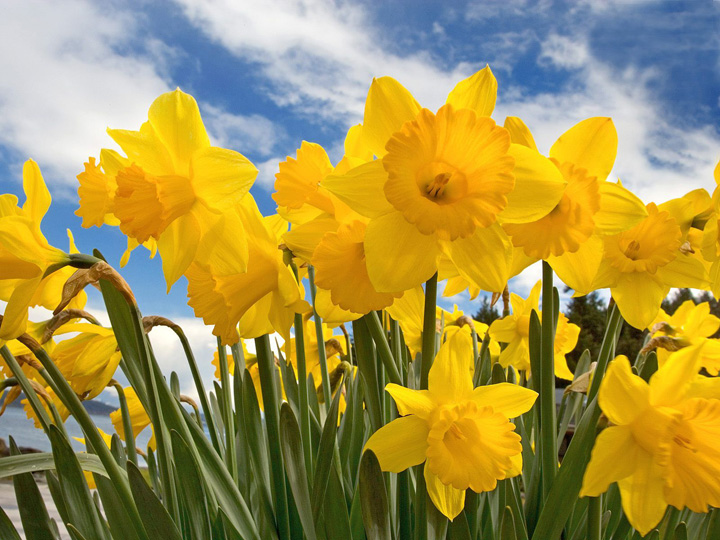
sunny_daffodils-2

Some years ago, on a Sunday in April, I accidentally left my car’s headlights on for three services of church. Suffice it to say, when I returned to the parking garage, my car was not having the “start” option. I remember being annoyed, not just at myself, but at the fact that I going to be in the lab later into the evening than I wanted to be. Grad school was stressing me out, and a dead car battery just was not what I needed that day.

Flustered, I called AAA, and they promised to send someone as soon as possible—but considering my situation wasn’t technically an emergency, I could be waiting for a while. After explaining the situation to the parking attendant (who was now going to have to stay late because of me), I sulkily settled down to wait on a seat outside the garage where I could see the AAA driver when he arrived.

As I pouted in my chair, my mind raced with all of the things I needed to do that day and later that week, and I grew more frustrated with each passing moment. Honestly, I can’t even remember what seemed so important at the time, but I’m sure it involved something along the lines of deadlines for grants and conferences or the list of bench work that constantly stayed in my mind even when I was procrastinating.

Then in the midst of my cranktastic mood, I noticed across the street that the landscape around my church and the surrounding neighborhood was dotted with beautiful daffodils in full bloom. It was odd; I didn’t remember seeing them that morning, even though my favorite part of spring is watching daffodils and tulips come into bloom. As I reluctantly admired them (I was enjoying my sour thought process far too much to allow joy), it dawned on me that I had not noticed the blooming of any flowers at all that spring—and it was late April! Surely by now I should have noticed at least a few tree-lined streets bashfully glowing with pink and white blossoms, the colorful bursts of Easter bouquets, or even gentle crocuses that peeped from the earth every spring by the student union on campus. Somehow, though, I had missed it all. And it wasn’t that we were experiencing a late spring that year. I had just stopped noticing the beauty of the world because I was too absorbed in myself and whatever was clearly so important at the moment. My focus locked on the daffodils…so insignificant…but so comforting.

Eventually, of course, the AAA guy arrived and jumped my car battery. I went to the lab and started working on whatever had been preoccupying me. Most likely I finished whatever I needed to, I really don’t remember anymore.

What I do remember, though, was that before I began working, I wrote on a little strip of paper “The Daffodils I Would Have Missed,” and I taped it in front of my bench in the lab. I wanted it to serve as a reminder. My drained car battery had frustrated me. It seemed pointless, a waste of time. Yet without that delay, that forced pause, I wouldn’t have noticed that spring was all around me. Each flower I saw that afternoon had seemed to be a tiny gift, something to make me smile. They calmed my frustrated nerves and reminded me there was a big, beautiful world outside of the small confines I had created in my head.

I know that God used that afternoon as a teaching moment for me. I’d like to say that I never forgot the lesson, but I’m a stubborn soul and I often have to learn lessons many times before they stick. In the years since then, I’ve encountered much bigger frustrations than a dead car battery, but they’ve often been accompanied by much bigger metaphorical daffodils. Alternately, I know I have ignored many a daffodil because I’ve refused to stop pouting in my seat, choosing instead to relish in misery and entitled self-pity.

In 2015, I want to stop pouting. There was too much of that in 2014. I allowed defeat to consume me too many times, and I’m sure I trampled over far too many daffodils in my frustration. So, for myself and everyone else, look for the daffodils! We don’t know what God is up to in our darkest moments. Even when feel at our lowest. Even when the windchill outside seems to be a made-up low number 😉

Mission: 2015

Well, friends, family, and cyber community, it’s 2015! That means a combination of things, not the least of which is that I will be signing the date incorrectly on all paperwork for the next month. Rolling into a new year means that, as per Western tradition, some folks will be trying to stick with New Year’s resolutions or break bad habits while other folks will hardly notice that anything has changed other than the calendar on the fridge. (But gold star if that calendar includes hockey players or firefighters with puppies.)

I will admit, I’ve never been much of one for New Year’s resolutions. I’m a Jedi Master when it comes to making excuses, but I would say that my inability to commit to a resolution largely boils down to laziness and a lack of accountability. Who wants to add more work (even if it’s worthwhile?) to their day, and if you’re not held accountable, who is going to notice? I think if I have a support system taking the plunge with me, maybe I will be more faithful to my endeavors.

Thus, I give you:

My 2015 Challenge to All of Us Together
Learn more about the natural world around us and start taking some stewardship steps!

Ok now, wait, wait, wait, before you tune out my save-the-environment shtick, let me give you a really big number: $124-145 trillion. Yes, you read that correctly, trillion. That’s the estimated value of ecosystem services in our global economy. So, on the one hand, our planet is amazing. From mighty volcanoes, to beautiful birds, to the vast and mysterious oceans, to this underappreciated lot, there is quite literally no end to the possibility of discovery and awe with every step outdoors. On the other hand, we quite literally need our natural world. In spite of such beauty and power to be thankful for, we often forget how much we actually rely on our natural resources and easily we can damage them. We may not notice all weather patterns or the water cycle (or the oxygen, nitrogen, and carbon cycles), but we certainly notice when something is wrong. Our planet’s basic processes play a role in everything from our food development to our recreational activities, yet we often take these processes for granted because we don’t necessarily dwell on pollinators in action or notice the consequences of impervious surfaces to stormwater runoff.

Thus, we must remember the words of that great philosopher, Uncle Ben from Spiderman: with great power comes great responsibility. We humans, we’re a reasonably intelligent bunch. Sure, we did produce Justin Bieber and these folks, but as a species, we have accomplished quite a great deal. We have power. And what’s more important, we can each make small choices that collectively have a tremendous impact.

So, what can we change for 2015? I know that most of you are aware of probably the majority of the items on this list below, but here are just a few of the things I personally want to be more focused on for this new year. If these are totally foreign, maybe the best idea would be to pick two new things and try to be faithful about those. At least in my experience, I know that if my starting goal is too big, I overwhelm myself and either give up or slowly stop caring (aye, my brain.) So, list, list, listy:

Recycling—This is a no-brainer. If you’re not already recycling, you have zilch excuses. I know that not all neighborhoods have recycling pickup, but most communities have drop-off locations that can be easily looked up on township websites. One of the more popular excuses I’ve heard not to recycle is that it isn’t cost-efficient because not enough of us in the US recycle. Um, know the easy fix to that? More of us should recycle! The contents of landfills seriously just don’t go away magically…they sit for years, and decades, and probably a very, very long time.

Reusable Shopping Bags—I’m super guilty of this one. I own a good number of reusable shopping bags. Half of them are in my car, half of them are merrily skipping about my apartment like pixies in Neverland. Yet somehow, whenever I go grocery shopping, I get up to the check-out line and realize that I don’t have a single bag with me. Fail. So, if you guys are in this with me, I’d super appreciate the camaraderie of other folks trying to remember their shopping bags too.

Change your Facewash—This was a new one for me in 2014. I had never really given much thought to what kind of exfoliants were scrubbing away those old, keratinized epithelial cells on the surface of my skin until I came across an article like this one. Many health and beauty products contain polyethylene microbeads—tiny bits of plastic to scrub away at that dead skin; but plastic doesn’t particularly decompose, it isn’t filtered out of our waste water, and it causes havoc in natural water ways. If you want to make this switch, look for polyethylene on the ingredients list. I switched to a facewash that uses powdered walnut shell instead, and it works great! (And I will clarify…I’m definitely not someone who always wants to be the first to use “natural” products just because they’re natural. Not because natural means bad, but because it doesn’t necessarily mean good or better. I might have do a post on this in the future sometime.)

Use Native Plants in Your Home Gardening–As native plants become more popular, they’re becoming somewhat more common at nurseries and you can most definitely find them if you want to! Using native plants means your greens and blooms are growing up in their best possible environment, which means less work for you, and you will be a magnet for pollinators (plus, you’re not adding the issues with invasive species.) You can also specifically try a pollinator garden. I’m no green thumb, but I know plenty of gardening enthusiasts who can make magic happen with just a watering bucket and a bit of weeding.

Buy Local–When you’re focusing on local businesses, you’re supporting a healthy economy and cutting back on the need for your products to be shipped hundreds or thousands of miles. Besides farm markets and small grocers, you can also look into farm shares (might be easier for bigger families, but I’ve wanted to try it!)

Try to Switch to Some Organic Foods–I know it’s more expensive, but I’m definitely a stickler for organic dairy and I try to buy organic produce whenever I can. Now, to be clear, organic foods are not good because they are “more nutritious.” Not at all. Rather, most organic foods have been produced using sustainable agricultural practices–at least in theory. To be USDA organic, they have to meet certain standards, many of which really do promote a decrease in pesticide and herbicide use. Of course, not all organic products are created equally (or are equally earth-friendly), but I figure it’s better to try!

Take Advantage of Learning Opportunities Around Your Town—I live in Pittsburgh, and we have some really great resources for learning about science and nature. We have the Carnegie Science Center, the Carnegie Museum of Natural History, the National Aviary, and the Pittsburgh Zoo and PPG Aquarium, in addition to educational efforts like the Citizen Science Lab, local chapters of the Audubon Society, and a number of other organizations. Take the opportunity to learn with these places! Many museums are now even regularly hosting events like 21+ Nights (like this or this), where you can check out all of the exhibits without having to awkwardly tell the six-year-old that it’s actually your turn to complete an electrical circuit and make the bell ring. Visit, have fun, and learn! And hey…if you have a few hours a month, volunteer. You won’t regret the experience 🙂

Make Learning a Habit—In our internet age, we quite literally have the world at our fingertips. We have access to educational resources unlike any generation has before us. Make learning something new about our world a daily habit! Heck, just sit down and Google anything that sounds interesting—why are scarlet macaws red? Where does drinking water come from? Why is the sky blue? What is the aurora borealis? What are the ocean trash patches? You can even get super fancy and hop over to Google Scholar where you are more likely to run into peer-reviewed sources.

**However, it’s a worth a note to please, please, please watch your internet sources. If a website looks or sounds like it was generated in somebody’s mama’s basement, it probably was. The best websites for information tend to end in .gov or .edu, or if you recognize them as a trusted source. Even .org sites can be sketchy (my favorite, honk when you get it), though certainly not always. And I’ll be real with you, this caution includes my own blog! I’m only a couple months out of grad school. I wrote half of this article on my living room couch, and half in my lab. I’m not a master, so don’t take my word for it. Check my resources. But I will say this: if the website tells you not to vaccinate your kids, run, hide, avert your eyes. It’s lying or ridiculous.**

So, are you ready for a 2015 challenge? Definitely post if you have other ideas, this list is by no means exhaustive. I just wanted to create a springboard for change, for positive action. If we each try just a little bit, we’re collectively doing a lot!

Peace, love, and science!

The Best of Both Worlds

Hebrews 11:1
“Now faith is being sure of what we hope for and certain of what we do not see.” (NIV, 2001 ed.)

I spent my last blog post exploring the general public’s idea of science and the scientific method. If anything, I hope I was able to convey that science is the process of testing ideas and hypotheses to draw conclusions about the natural, physical world. As a quick refresher summary, science is quantifiable; it’s observable, measurable, reproducible, and concrete. Sure, sometimes the process can be darn murky (I’m actually cross-eyed with some of my own confusing data at the moment and procrastinating by writing this) and sometimes it becomes too complex for a simple mind like mine to visualize. On the whole, though, science tries to build up evidence and draw conclusions based on that evidence.

Now if we turn to the flip side…what is faith? The whole point of my blog is that I’m a person who loves science, but I’m also very faith-based and love my God as well. I opened up this post with Hebrews 11:1 because I think it captures a very important distinction between science and faith: faith is trusting something even when traditional “evidence” is absent. I can’t bottle God, design an experiment to test His power or even His existence, and I certainly can’t quantify anything about Him. There is no statistical test that will ever demonstrate His significance (nhaha, see what I did there?), and I can’t present the kind of reproducible data that would ever sway a non-believer or impress reviewers for a journal.

So why on earth would I enjoy having these two facets in my life? On the one hand, I selected a career path that has trained me to be skeptical and critical of how someone arrives at a conclusion (well, at least a good number of folks have tried to help me think this way…definitely a work in progress). On the other hand, I put the ultimate confidence of my life in Someone that I will probably never see with my own eyes while I’m alive on this Earth. In a way, these two different directions are almost opposing absolutes—sometimes complementary, sometimes in seeming opposition.

For me, though, there are two ways around this impasse. The first is that I don’t hold science or the scientific method itself as the be-all, end-all. It is an incredibly powerful way of answering questions, but it always will be limited by our knowledge, intellect, creativity, and technology. Heck, Louis Pasteur did away with thousands of years of ideas behind spontaneous generation by simply bending a tube. Giant Disclaimer: I’m not by any means saying I don’t trust modern science. (So please vaccinate your kids and reduce, reuse, recycle, dagnabbit.) I am saying that just because we can’t or don’t know how to test something, we don’t necessarily have to negate its value or authenticity. How on earth can you test spirituality? To my knowledge, you can’t. Does that mean spirituality has no value? Well, the ancient Egyptians thought the brain was a useless lump in our skulls, but they had no way to test that idea. That sure as crikey didn’t mean the brain actually was useless though.

Second, and probably the weightier factor for me, is that I’m willing to accept a very different kind of “proof” with my faith: my own story and experiences. Now don’t get me wrong; I will be the first to cry foul when someone tries to pawn off anecdotal evidence as data, especially if they’re trying to tell me how they cured cancer with cod liver oil and bean sprouts or something. And heck, out there on the interwebzz, you can find a shockingly scandalous conspiracy theory or goofy tale for just about anything. Beyond that, though, I mean our full personal stories, our own history and experiences. Our personal stories shape our emotions, influence what political beliefs we will adhere to, and help make decisions about novel situations (this version is easier for that one). Our stories are really what make us. As for my faith, my story and my life experiences all say that there is Something out there controlling random chance. There is a sense of deeper meaning and value than I have ever found in science, and there are life experiences that I can’t explain away with any reasonable answer.

I love this quote by C.S. Lewis:

“If the whole universe has no meaning, we should never have found out that it has no meaning: just as, if there were no light in the universe and therefore no creatures with eyes, we should never know it was dark. Dark would be without meaning.”

It’s more on the philosophical side, and I’m sure there are plenty who would debate me on it. Indeed I have a number of friends who don’t even think there really is any ultimate meaning in life. Now be sure to note, I’m not here to judge that belief or the people who hold it. Rather, my point is that I personally don’t know how to ignore the idea that every person I’ve ever met is worth more than the simple generational act of passing on one’s genes. We’re worth more than just being polite or being a “good person,” whatever that really means. Maybe this is just me being too anthropocentric. Maybe I’m biased because I’m just lucky and have gotten to meet some really awesome folks in my life. Maybe I’m too full of myself to believe I’m worthless #rockstar #clearly

Or maybe…just maybe…each one of us really is loved and valued by Someone,  from somewhere outside our own little worlds.

Well, agree with me or call me crazy. Science will never tell me if I’m right on that last bit or not, but I’m cool with that. I’m going to keep on running the in-between ground—learning about God and teaching folks all the nerdy tidbits I can find! And now you know what to expect from me if you come back in the future.

Peace, love, and science!


P.S. Sorry about the lateness of this post…too much fun happening around the 4th of July. Stay tuned for my next post, though! You’ll learn more than you ever realized you needed to about reptiles!

*Oo! Like my C.S. Lewis quote, want to see some crazy animals that really do live in a world without light? Check out the blind salamander, Mexican blind cave fish, and virtually anything that lives below the photic zone in the ocean. Just watch out for these bad boys. And these.

One More Blog Out There

Hi there, family and friends! I have started a blog.*

What Will my Blog be About?

I’m still conceptualizing it, but I have some ideas. First of all, I love science (as my friends roll their eyes and say they had no idea.) Short of filling my Facebook newsfeed with geeky stories every two minutes, I thought perhaps I could channel some of the science headlines that I want to share in a more organized fashion. With a nerdy blog, I can make a list of really cool animals or volcanoes if I want to! I can describe a single species ad nauseam if I want—if I want no readers. Or I can share some of the awesome headlines of the day. The sky’s the limit! Well, my obsession with “Once Upon a Time” on NetFlix might be the limit; but, you know, same thing.

Second, I’m most definitely a faith-based person, and I like exploring different ideas within my faith and how they relate to science. The Great Debates that seem to occur in the comments sections of 10,001 different news pages, YouTube, Facebook, and all other cyber spots out there seem to indicate that you can either be scientific or you can be someone who believes in a higher power. I say pish-posh to the narrows! Don’t believe me? Well I guess you’ll have to stay tuned.

What Are My Bloggy Goals?

First, I would love to spark excitement about science! Stats show the US is lagging in scientific literacy compared to the rest of the developed world, but I think that when folks can see that science isn’t just a textbook—it’s an exciting way to learn about the amazing world around us—maybe that literacy level might change. So much of our world today requires some basic background knowledge, we owe it to ourselves to be informed citizens before heading to the polls or making various choices in our daily lives. Just look in the news—vaccines, global climate change, cancer, energy development, rises in autism diagnoses, seafood, organic vs. non-organic foods, the World Cup (wait…)—all of these topics and others require more knowledge than what you get in a newspaper article if you want to have a meaningful discussion. Part of the problem, though, is that there is a gap between the general public and the scientific community. We can speculate all we want about what’s causing the gap, but the only thing I know to do is inspire you to learn more. Plus, our world is darn cool. No, our planet is awesome! I’m blanking on really strong adjectives, but when you come up with one, that’s our universe! As I get going with this blog, I’ll admit that I’m definitely going to be biased towards biology since that’s where my training comes from, but I can admire and appreciate other disciplines from afar. Quantum mechanics…very afar.

Second, I’ll admit this is kind of a left-field reason, I want to help homeschooling families with science at home. I was homeschooled K-12 and I had a great experience with it. English was my mom’s second language and she only had a GED, but she was tremendously dedicated to my education. My sister and I never fell below the 90th academic percentile, and good heavens’ knows it wasn’t because we’re unusually smart (well, my sister is.) We simply had a mom who made our education and life experiences her first priorities. I believe that any motivated parent can do that as well, and I want to help! Science at home isn’t easy, though. Ask my mom. By high school, I needed tutoring for chemistry and physics, and we were always looking for creative explanations and experiments for me to bridge some gaps. Now, to be perfectly honest, I never really bonded with chemistry and I certainly never fell for physics, but I made some decent progress in my own little corner of the scientific community. Now I want to go back and help the folks who are where I was ten-fifteen years ago. Hopefully I can serve up some suggestions on how to supplement your selected curriculum and go deeper than the dusty pages.

Third, I want to foster a better relationship between the church and members of the scientific community. Since I have roots in both faith and science, I’m at a better point than most to understand the deeper significance behind all the confusion, dislike, rejection, and miscommunication on some very important and yet incredibly sensitive subjects in science. As someone who was raised conservatively and still believes in my Lord and Savior, I understand exactly how frustrating it can be to talk to an evolutionary biologist who doesn’t know or care why you believe what you do, but rather is only concerned with telling you how wrong you are and insulting your intelligence because of it. On the flip side, evolution was the subject of one of my doctoral qualifying exams, and I could probably tell you more about a molecular clock than I can the digital clock on my cell phone. The thing is, though, I’ll be upfront and say I’m not in it to instantly change minds. I just want to clear up some confusion, share some information, put the discussion on a better playing field, and hopefully diffuse some of the tension. I don’t like deriding comments coming from members of either the church or academic community, but I get both and I’m sure there are plenty of others who do as well. I just want to be a peacemaker J It doesn’t have to be science or faith. Unite the kingdoms! (But only if there’s a really hot prince in it for me…otherwise, we can just be friendly neighbors.)

Fourth: woman in science (drops the mic.)

Wrap up the Rambling**

I think this will do it for today. For future reference, I can’t picture myself coming up with more than one or two posts per week, but I guarantee you will get your full dose of Maria in each one (take that as either good or bad). I’m also going to guess that for a while, I’m going to be posting more gee-whiz kinds of things rather than diving into the deep, but we’ll get there. Hopefully this all made sense and sounds like something worth reading!

Peace, love, and science!


*Does that count as a complete introduction? Ok, cool. I can check that part off my list. I stared at my computer screen for about three minutes, unintentionally making an angry duckface, until I decided a pleasant greeting and statement of the obvious would suffice.


**Does that still count as alliteration?