Snakey Superlatives

Oh, you lucky duck, you! Here’s your one-stop shopping for all your mind-blowing, legless Squamate factoids for the day! (Except legless lizards…those kind of creep me out. Eep.) I wasn’t feeling a hard-science post, but there’s always fun to be had in the biology world! As a disclaimer, there isn’t a lot of rhyme or reason to today’s spewing of info, I just had a lot of fun snake tidbits in mind that I wanted to share. So look at today’s thought-process grandeur as a snapshot of what it’s kind of like to be in my brain. Except my brain is more glittery.
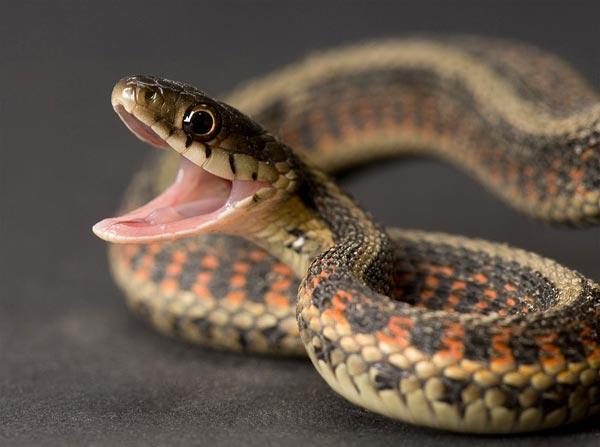
snake

Credit: National Geographic

General Overview: Snakes are a group of long-bodied, legless* reptiles. (*I say “leg-less” with the quick caveat that some snakes do have teeny-tiny vestigial “leg” nubs.) As reptiles, they’re ectothermic, or “cold-blooded,” which means they can’t regulate their body temperature they way we can and instead rely on their environment and behavioral modifications (e.g., basking on a rock in the sun on a warm day.) Hand-in-hand with the energy conservation involved in their thermal regulation, snakes also have some amazing metabolic adaptations. Snakes can lower their metabolic rates, delaying the need for food. In fact, some snakes can go months without eating, and sea snakes can go up to seven months without drinking! (But don’t use that as an excuse not to feed/water your pet snake, please and thank you 🙂  In other snakey fast-facts, our vertically-challenged, slithery friends don’t have eyelids, but they do have protective brilles–a clear scale over each eye. Snakes also regularly undergo ecdysis–the shedding of their skin (including the brilles). Also, snake diets depend on the species but range from ants and termites to small rodents and reptiles to larger mammals, birds, and other snakes. How’s that for a carnivore?

Now the title of this post is “Snakey Superlatives”…so naturally, I have included some snakey superlatives. Ready?


Your Worst Nightmare Snake

Titanoboa cerrejonensis may be long-extinct, but it’s still a wonder to hear about. This monster could be as much as 40 feet long, weigh over a ton, and at its widest point, its body could be 3-4 feet high. The largest known snake in history, the species could probably send shivers up the spine of even today’s bravest herpetologist. Simultaneously awesome and terrifying.

titanoboa


The Biggest Extant Species of Snake

Kind of depends on what we count as biggest. The green anaconda (Eunectes murinus) typically goes down on record with the reticulated python (Python reticulates) as being the largest snake in the world, but it depends on whether length or mass is considered. Green anacondas are the most massive, weighing in at up 550 lbs when 20-30 feet long, but reticulated pythons can be longest with a record length of 32 feet and weighing ~350 lbs.

anaconda

Green Anaconda, credit Arkive


Smallest Snake in the World

Maybe the big boys aren’t quite your thing, so what about the smallest snake in the world? The Barbados threadsnake (Leptotyphlops carlae) grows to only about 10 cm long and it subsists on ants and termites. How cute is that?

Barbados threadsnake

Barbados Threadsnake, credit National Geographic

Prettiest Snake in the World

Perhaps a slightly subjective assessment, I’ll admit, but the emerald tree boa (Corallus caninus) is a gorgeous green to blend in its South American forest home.
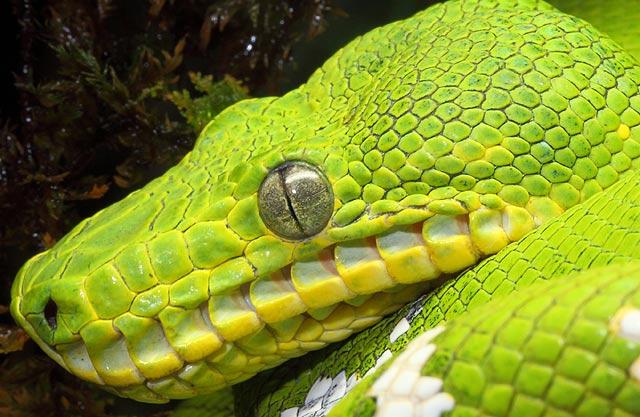
emerald tree boa

Emerald Tree Boa, credit National Aquarium


World’s Largest Gathering of Snakes

Yeah, you’re just gonna have to watch this one.

While I have your attention, though, I think it would be best if I dispelled a few myths about snakes. Out of casual observation, I would say this group of animals gets the most undeserved fear of most taxa.

Myth: Snakes are highly aggressive and should always be “taken care of,” mob style

As a good rule of thumb, if you don’t bother them, they won’t bother you. As predators, snakes are incredibly important members of their communities, and minimizing the disruption of food webs is a noteworthy goal on our part. That being said, if you do see a rattlesnake–please walk away and take your dog and small children with you. Big children, too, probably. (This safety page was directed at Florida residents, but it’s fairly reasonable for anyone–though I admit even I raised an eyebrow at the trash can method.)

Myth: Snakes unhinge their jaws to eat.

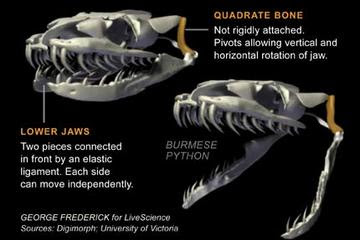
They’re not really unhinging their jaws. Snakes just have a much more kinetic skull than we do—they have a greater number of movable joints. If you feel your lower jaw, it’s one solid bone. When you were much younger, though, you used to have a “joint” down the midline of your jaw (think of an invisible line extending straight down from below your two middle front teeth). This was never a movable joint, though since we don’t particularly need a joint there, and the two halves of your jaw fused together as you progressed in development, forming the mandibular symphysis.

On the other hand, snakes have several kinetic points in their jaws that allow them to open their mouths multiple times as large as their head normally appears when resting. Since snakes don’t chew their food, they need to able to swallow their dinner whole.snake jaw
Myth: Snakes are poisonous.

Nope nope nope nope nope nope nope…wait for it…nope! (Ok, there is one genus of legitimately poisonous snakes in the world.) But copperheads, rattlesnakes, cobras, bushmasters, vipers, etc—not poisonous!

However, there are plenty of venomous snakes in the world.

What’s the difference you say? Well, poisons are secreted, generally somewhere on the surface of an animal’s body. Animals like toads and newts can be poisonous. If you try to eat them, you could get very sick, have a very “strange” evening, or both. A way to remember, poison is ingested, venom is injected.

So snakes are pretty awesome, are you convinced yet? If not, don’t worry, I can post lots more snakey things to change your mind.

Until next time,

Peace, love, and science!
The Best of Both Worlds

Hebrews 11:1
“Now faith is being sure of what we hope for and certain of what we do not see.” (NIV, 2001 ed.)

I spent my last blog post exploring the general public’s idea of science and the scientific method. If anything, I hope I was able to convey that science is the process of testing ideas and hypotheses to draw conclusions about the natural, physical world. As a quick refresher summary, science is quantifiable; it’s observable, measurable, reproducible, and concrete. Sure, sometimes the process can be darn murky (I’m actually cross-eyed with some of my own confusing data at the moment and procrastinating by writing this) and sometimes it becomes too complex for a simple mind like mine to visualize. On the whole, though, science tries to build up evidence and draw conclusions based on that evidence.

Now if we turn to the flip side…what is faith? The whole point of my blog is that I’m a person who loves science, but I’m also very faith-based and love my God as well. I opened up this post with Hebrews 11:1 because I think it captures a very important distinction between science and faith: faith is trusting something even when traditional “evidence” is absent. I can’t bottle God, design an experiment to test His power or even His existence, and I certainly can’t quantify anything about Him. There is no statistical test that will ever demonstrate His significance (nhaha, see what I did there?), and I can’t present the kind of reproducible data that would ever sway a non-believer or impress reviewers for a journal.

So why on earth would I enjoy having these two facets in my life? On the one hand, I selected a career path that has trained me to be skeptical and critical of how someone arrives at a conclusion (well, at least a good number of folks have tried to help me think this way…definitely a work in progress). On the other hand, I put the ultimate confidence of my life in Someone that I will probably never see with my own eyes while I’m alive on this Earth. In a way, these two different directions are almost opposing absolutes—sometimes complementary, sometimes in seeming opposition.

For me, though, there are two ways around this impasse. The first is that I don’t hold science or the scientific method itself as the be-all, end-all. It is an incredibly powerful way of answering questions, but it always will be limited by our knowledge, intellect, creativity, and technology. Heck, Louis Pasteur did away with thousands of years of ideas behind spontaneous generation by simply bending a tube. Giant Disclaimer: I’m not by any means saying I don’t trust modern science. (So please vaccinate your kids and reduce, reuse, recycle, dagnabbit.) I am saying that just because we can’t or don’t know how to test something, we don’t necessarily have to negate its value or authenticity. How on earth can you test spirituality? To my knowledge, you can’t. Does that mean spirituality has no value? Well, the ancient Egyptians thought the brain was a useless lump in our skulls, but they had no way to test that idea. That sure as crikey didn’t mean the brain actually was useless though.

Second, and probably the weightier factor for me, is that I’m willing to accept a very different kind of “proof” with my faith: my own story and experiences. Now don’t get me wrong; I will be the first to cry foul when someone tries to pawn off anecdotal evidence as data, especially if they’re trying to tell me how they cured cancer with cod liver oil and bean sprouts or something. And heck, out there on the interwebzz, you can find a shockingly scandalous conspiracy theory or goofy tale for just about anything. Beyond that, though, I mean our full personal stories, our own history and experiences. Our personal stories shape our emotions, influence what political beliefs we will adhere to, and help make decisions about novel situations (this version is easier for that one). Our stories are really what make us. As for my faith, my story and my life experiences all say that there is Something out there controlling random chance. There is a sense of deeper meaning and value than I have ever found in science, and there are life experiences that I can’t explain away with any reasonable answer.

I love this quote by C.S. Lewis:

“If the whole universe has no meaning, we should never have found out that it has no meaning: just as, if there were no light in the universe and therefore no creatures with eyes, we should never know it was dark. Dark would be without meaning.”

It’s more on the philosophical side, and I’m sure there are plenty who would debate me on it. Indeed I have a number of friends who don’t even think there really is any ultimate meaning in life. Now be sure to note, I’m not here to judge that belief or the people who hold it. Rather, my point is that I personally don’t know how to ignore the idea that every person I’ve ever met is worth more than the simple generational act of passing on one’s genes. We’re worth more than just being polite or being a “good person,” whatever that really means. Maybe this is just me being too anthropocentric. Maybe I’m biased because I’m just lucky and have gotten to meet some really awesome folks in my life. Maybe I’m too full of myself to believe I’m worthless #rockstar #clearly

Or maybe…just maybe…each one of us really is loved and valued by Someone,  from somewhere outside our own little worlds.

Well, agree with me or call me crazy. Science will never tell me if I’m right on that last bit or not, but I’m cool with that. I’m going to keep on running the in-between ground—learning about God and teaching folks all the nerdy tidbits I can find! And now you know what to expect from me if you come back in the future.

Peace, love, and science!


P.S. Sorry about the lateness of this post…too much fun happening around the 4th of July. Stay tuned for my next post, though! You’ll learn more than you ever realized you needed to about reptiles!

*Oo! Like my C.S. Lewis quote, want to see some crazy animals that really do live in a world without light? Check out the blind salamander, Mexican blind cave fish, and virtually anything that lives below the photic zone in the ocean. Just watch out for these bad boys. And these.

Talking to Strangers

I’m an oddball, so I do odd things. Just keep that in mind as you read through this post!

Introduction
I mentioned in my last post that there is often a bit of a disconnect between the scientific community and those who don’t necessarily spend a lot of time in the lab. This makes complete sense, of course. With different careers come different training and different levels of exposure to concepts and terminology. I wouldn’t know the first thing about running a business, designing dresses, performing a root canal, selling software, or fixing computers (good golly, I could not fix a computer to save my favorite burrito.) The problem, though, is that our everyday worlds are impacted by science—from medical situations to energy choices to what food we eat. That means communication gaps may not be the best thing ever.

I was curious about the idea of a disconnect in communication, though. Where does the break-down start? Where does confusion first come in to play? So I started at the very beginning, something basic: what is science? Is everyone on the same page there? Most scientists would probably be ok with my broadly defining science as “using the scientific method to understand the processes, interactions, constants, and dynamics of the world and universe around us.” In that sense, an understanding of the scientific method is fairly important as well. Thus, my goal for today was just to determine how folks outside of the scientific community define science and the scientific method.

Methods
I spent roughly two hours on Friday afternoon walking around downtown my mid-sized city and asking people on the street what they thought of when they heard the word “science” or the phrase “scientific method.” (Yup, I’m weird. But, hey, I like talking to people.) I explained to my recruits that I was writing a blog post on how science is viewed from outside the scientific community, and most folks seemed interested in the topic.

I will admit my sampling was not completely random. I selected participants who appeared generally friendly (as opposed to angry, cranky, scary, or mean), were not wearing ear buds, and did not appear to be in a hurry. Most of them were on smoke breaks outside of corporate high-rises, and I tried to pick out participants whose ages were approximately twenty-five years or older to make sure I wasn’t creeping out any kids. In the end, I had a sample size of sixteen individuals (ahem, n=16).

Results
What is Science?
I had quite a variety of answers to the question “What is science, or what do you think of when you hear the word ‘science’?” They ranged from philosophical to silly, and they were sometimes a solo statement, or a group effort (when I caught the smoke-breakers). Their responses were:

“I hear ‘science’ and I think experiments and research.”

“Well, there’s all types of science. I guess I don’t know what I think of specifically.”

“Science is the universe, it’s everything. From the smallest thing to the largest thing. Science is what we are.”

“Science is a mysterious thing to me. I’d rather not know.”

“I think mermaids. Mermaids and tornadoes.”
“Don’t listen to him, he does not!”
“Yes I do! It’s Friday afternoon, my brain is mush, and I think science is mermaids and tornadoes.”

“It’s research, tangible things, and experiments.”

“I hear science and I think smart people. I think of smart people looking at the universe—looking at the sun, the stars, the moon, everything!”

“I don’t know. I guess I hear ‘science’ and I think beakers and test tubes. And chemicals. And maybe Frankenstein if you mean movies.”

“Science seems like difficult things. But I like microbiology.”

“Arriving at conclusions mathematically.”

“Science is research and discovering things.”

What is the Scientific Method?
There was less variety when I asked folks to describe the scientific method. Almost uniformly, people had not heard the phrase, though they often had some idea of what I meant. Their responses were:

“The scientific method? I don’t know, you research, dig, compare, mathematically answer questions.”

“I don’t know.”

“No clue.”

“What’s that what?”

“Is this a Scientology question?”

“No idea.”

“The scientific method…I don’t know the exact definition, but I know you have to devote a lot of time and energy to it.” (author’s note: darn right!)

“The scientific method…I don’t know.”

{Laughter accompanied by shrugs all around}

“I have no idea.”

“No idea.”

“The scientific method is when you follow all those steps, you know, starting with a hypothesis.” (outlier, her sister is working on her PhD in biology)

Discussion
There is at least some element of truth to all of the answers I received (well, minus the mermaids, but I’ll be super excited if you ever find one). A lot of folks mentioned research, experiments, testing things, and “mathematically” determining an answer. Also, most folks touched on the idea that science deals with the natural or physical world.

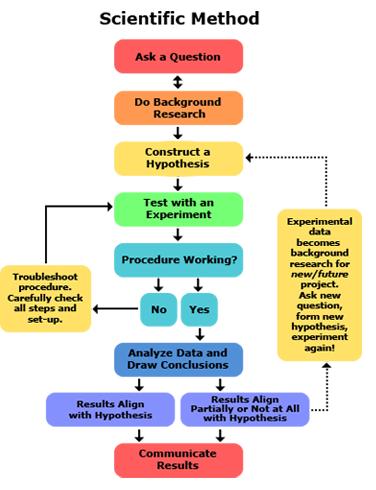
For me, the biggest surprises were the answers about the scientific method. The concept has been a part of my daily life for the past decade. I’m certainly not a master of it, but I’m very familiar with it. For anyone reading who might still be a bit murky on the subject, the scientific method can be quickly summarized by this flow chart I found floating around ze interwebz.

sci method

What this flow chart is showing is a process—a way of systematically trying to reach an answer by testing ideas, refining hypotheses, trying experiments, ruling out when ideas don’t work, supporting ideas with evidence, and sometimes (it hurts!!) starting all over. This is essentially what science is all about. Seems very simple, but it’s a tremendous tool. The concept is used by folks who work with proteins, DNA, yeast, bacteria, plants, animals, chemicals, forces, quarks, nanoparticles, and all manner of crazy stuff.

I guess the take-home message I’m trying to convey is that science is a process. It’s a quest for knowledge. And if science is a quest, the scientific method is the treasure map. If we want to help bridge the communication gap between the scientific community and all of the other communities we work alongside, we need to help folks read the map!

One More Blog Out There

Hi there, family and friends! I have started a blog.*

What Will my Blog be About?

I’m still conceptualizing it, but I have some ideas. First of all, I love science (as my friends roll their eyes and say they had no idea.) Short of filling my Facebook newsfeed with geeky stories every two minutes, I thought perhaps I could channel some of the science headlines that I want to share in a more organized fashion. With a nerdy blog, I can make a list of really cool animals or volcanoes if I want to! I can describe a single species ad nauseam if I want—if I want no readers. Or I can share some of the awesome headlines of the day. The sky’s the limit! Well, my obsession with “Once Upon a Time” on NetFlix might be the limit; but, you know, same thing.

Second, I’m most definitely a faith-based person, and I like exploring different ideas within my faith and how they relate to science. The Great Debates that seem to occur in the comments sections of 10,001 different news pages, YouTube, Facebook, and all other cyber spots out there seem to indicate that you can either be scientific or you can be someone who believes in a higher power. I say pish-posh to the narrows! Don’t believe me? Well I guess you’ll have to stay tuned.

What Are My Bloggy Goals?

First, I would love to spark excitement about science! Stats show the US is lagging in scientific literacy compared to the rest of the developed world, but I think that when folks can see that science isn’t just a textbook—it’s an exciting way to learn about the amazing world around us—maybe that literacy level might change. So much of our world today requires some basic background knowledge, we owe it to ourselves to be informed citizens before heading to the polls or making various choices in our daily lives. Just look in the news—vaccines, global climate change, cancer, energy development, rises in autism diagnoses, seafood, organic vs. non-organic foods, the World Cup (wait…)—all of these topics and others require more knowledge than what you get in a newspaper article if you want to have a meaningful discussion. Part of the problem, though, is that there is a gap between the general public and the scientific community. We can speculate all we want about what’s causing the gap, but the only thing I know to do is inspire you to learn more. Plus, our world is darn cool. No, our planet is awesome! I’m blanking on really strong adjectives, but when you come up with one, that’s our universe! As I get going with this blog, I’ll admit that I’m definitely going to be biased towards biology since that’s where my training comes from, but I can admire and appreciate other disciplines from afar. Quantum mechanics…very afar.

Second, I’ll admit this is kind of a left-field reason, I want to help homeschooling families with science at home. I was homeschooled K-12 and I had a great experience with it. English was my mom’s second language and she only had a GED, but she was tremendously dedicated to my education. My sister and I never fell below the 90th academic percentile, and good heavens’ knows it wasn’t because we’re unusually smart (well, my sister is.) We simply had a mom who made our education and life experiences her first priorities. I believe that any motivated parent can do that as well, and I want to help! Science at home isn’t easy, though. Ask my mom. By high school, I needed tutoring for chemistry and physics, and we were always looking for creative explanations and experiments for me to bridge some gaps. Now, to be perfectly honest, I never really bonded with chemistry and I certainly never fell for physics, but I made some decent progress in my own little corner of the scientific community. Now I want to go back and help the folks who are where I was ten-fifteen years ago. Hopefully I can serve up some suggestions on how to supplement your selected curriculum and go deeper than the dusty pages.

Third, I want to foster a better relationship between the church and members of the scientific community. Since I have roots in both faith and science, I’m at a better point than most to understand the deeper significance behind all the confusion, dislike, rejection, and miscommunication on some very important and yet incredibly sensitive subjects in science. As someone who was raised conservatively and still believes in my Lord and Savior, I understand exactly how frustrating it can be to talk to an evolutionary biologist who doesn’t know or care why you believe what you do, but rather is only concerned with telling you how wrong you are and insulting your intelligence because of it. On the flip side, evolution was the subject of one of my doctoral qualifying exams, and I could probably tell you more about a molecular clock than I can the digital clock on my cell phone. The thing is, though, I’ll be upfront and say I’m not in it to instantly change minds. I just want to clear up some confusion, share some information, put the discussion on a better playing field, and hopefully diffuse some of the tension. I don’t like deriding comments coming from members of either the church or academic community, but I get both and I’m sure there are plenty of others who do as well. I just want to be a peacemaker J It doesn’t have to be science or faith. Unite the kingdoms! (But only if there’s a really hot prince in it for me…otherwise, we can just be friendly neighbors.)

Fourth: woman in science (drops the mic.)

Wrap up the Rambling**

I think this will do it for today. For future reference, I can’t picture myself coming up with more than one or two posts per week, but I guarantee you will get your full dose of Maria in each one (take that as either good or bad). I’m also going to guess that for a while, I’m going to be posting more gee-whiz kinds of things rather than diving into the deep, but we’ll get there. Hopefully this all made sense and sounds like something worth reading!

Peace, love, and science!


*Does that count as a complete introduction? Ok, cool. I can check that part off my list. I stared at my computer screen for about three minutes, unintentionally making an angry duckface, until I decided a pleasant greeting and statement of the obvious would suffice.


**Does that still count as alliteration?